

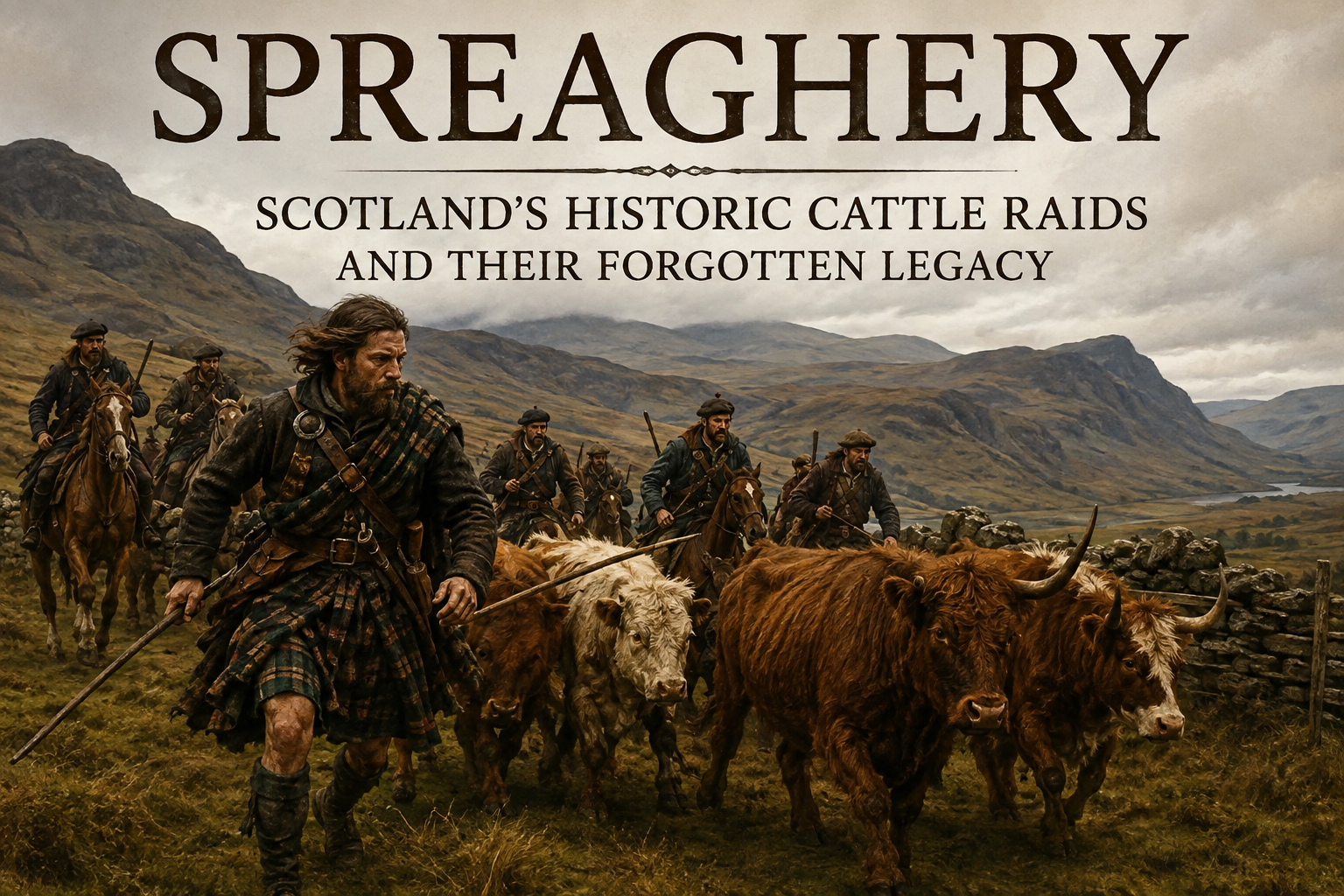
I have always found old words fascinating, especially the ones that seem to carry an entire story inside them. A few unusual letters can sometimes open a door into a completely different world.
That is exactly what happened when I came across the word Spreaghery.
At first glance, it looks like one of those strange words that might have been invented for a fantasy novel. But Spreaghery is a genuine historical term. It was used in Scottish contexts to describe cattle lifting, raiding, plundering, and the booty taken during such activities.
The more I learned about it, the more interesting it became. Spreaghery is not simply an old word for stealing cattle. It connects language with Highland history, clan conflict, survival, property, and the complicated social world of earlier Scotland.
So, let’s take a closer look.
What Does Spreaghery Mean?
In simple terms, Spreaghery refers to the practice of raiding or stealing cattle, particularly in the historical Scottish context.
Merriam-Webster defines it as cattle lifting or plundering and also gives the word a second sense referring to booty or plunder.
Collins similarly describes Spreaghery as the activity or crime of raiding cattle in Scottish history.
That makes the word particularly interesting because it can describe both the act of raiding and, in some historical usage, the property acquired through plunder.
If you have never encountered the term before, you are certainly not alone. It is an uncommon word today and is mainly useful when reading about Scottish history, old literature, dictionaries, or historical accounts.
Spreaghery in Simple Language
If I had to explain it to a friend over coffee, I would put it this way:
Spreaghery was a form of cattle raiding or livestock plundering associated with historical Scotland.
The closest modern expression would probably be something like cattle rustling, although the historical circumstances surrounding Spreaghery were much more complicated.
Where Did the Word Come From?
One of the things I enjoy about unusual vocabulary is discovering how the word developed.
Spreaghery is connected to the word spreagh, which Merriam-Webster defines as a Scottish term for a cattle raid or foray. The dictionary traces spreagh as an alteration of “spreath.”
The ending “-ery” gives the word the sense of an activity, practice, or type of behavior.
There is also a recognized variant spelling, sprechery. Collins lists sprechery as a variant of Spreaghery.
This is worth remembering because historical texts did not always use perfectly standardized spelling. When dealing with older vocabulary, finding alternative spellings can make research much easier.
Why Was Cattle So Important?
To understand Spreaghery, I think it helps to understand the value of cattle in earlier societies.
Today, losing a few farm animals would certainly be a serious problem for a farmer, but modern economies give us many alternatives for earning money and replacing property.
In earlier rural communities, cattle could represent a significant part of a family’s wealth.
Cattle provided food, materials, breeding stock, and economic value. They could also be exchanged or sold. Taking someone’s cattle was therefore much more than taking an animal.
It could directly affect that person’s ability to survive.
This helps explain why cattle raids could become such an important part of historical conflicts.
Spreaghery and Scottish History
When I first encountered the word, I imagined a simple story involving thieves sneaking onto a farm and taking a few cows.
The historical reality was much broader.
Scottish history includes periods when disputes between communities, families, and clans could involve raids and retaliatory actions. In that environment, livestock could become a target.
Spreaghery therefore belongs to a larger history of cattle raiding, clan conflict, plundering, and rural life.
It is important, however, not to romanticize the practice. Historical stories about raiders can sometimes make these events sound adventurous or heroic.
For the people who lost their livestock, the experience could have been devastating.
A Word Connected to Conflict
A cattle raid could create consequences that extended far beyond the original theft.
One raid might encourage retaliation. Retaliation could lead to another raid, and disputes could continue for years.
That makes Spreaghery interesting from a historical perspective because the word represents more than an isolated crime. It can help us understand how property, power, and conflict interacted in earlier rural communities.
What Was the Difference Between Spreaghery and Ordinary Theft?
This is one of the questions I found most interesting.
Modern readers might immediately translate Spreaghery as simply “theft.” That is understandable, but it misses some of the historical context.
Spreaghery specifically relates to cattle lifting and plundering, while ordinary theft can refer to taking almost any property.
The term also carries a distinctly historical and Scottish association.
In other words, calling every type of theft Spreaghery would not be accurate.
Think of it as a specialized historical word describing a particular form of raiding.
Spreaghery and the Meaning of Plunder
Another fascinating aspect of the word is its connection to plunder.
Historical dictionary material gives Spreaghery a meaning involving booty, prey, or property obtained through depredation.
That gives the word two sides.
On one side, there is the action itself: raiding or taking livestock.
On the other, there is the result: the property or booty acquired through the raid.
This is a useful reminder that old words often carry meanings that have changed or narrowed over time.
How Do You Pronounce Spreaghery?
This was one detail I wanted to check because the spelling can be intimidating.
Collins gives the pronunciation as approximately “sprex-uh-ree.”
The “gh” combination may make the word look much harder than it actually is.
If you are reading the word aloud, the pronunciation is roughly:
Spreaghery: SPREK-uh-ree
Pronunciation guides can vary slightly, especially with historical or regional vocabulary, so I would not worry about achieving a perfect accent.
The important thing is recognizing the word when you encounter it.
Why Is Spreaghery Rare Today?
The simplest answer is that the practice it describes is no longer a normal part of everyday Scottish life.
Language changes when society changes.
As legal systems, farming practices, transportation, policing, and economic structures developed, the circumstances associated with historical cattle raiding changed as well.
Naturally, the word became less common.
Today, you are much more likely to encounter Spreaghery in a dictionary, historical novel, academic discussion, or writing about Scotland than in everyday conversation.
That rarity is actually part of its charm.
My Tip for Learning Rare Historical Words
One thing I have learned from exploring unusual vocabulary is that memorizing a definition alone rarely works.
Instead, I try to connect the word with an image or story.
For Spreaghery, I picture a historical Scottish landscape, a group of cattle being driven away, and the tense aftermath of a raid.
That mental picture makes the word much easier to remember.
Related Words and Concepts
If you are researching Spreaghery, several related terms can help you understand the subject more completely.
Here are a few worth knowing:
- Cattle raiding: The practice of taking cattle from another person’s land.
- Cattle rustling: A more familiar modern expression for stealing cattle.
- Plunder: Property taken by force or during a raid.
- Booty: Goods or property acquired through conflict or raiding.
- Clan conflict: Disputes and struggles between Scottish clans that provide important historical context.
These terms create a useful vocabulary network around Spreaghery.
What Spreaghery Can Teach Us About Language
For me, this is where the word becomes especially fascinating.
A dictionary definition might take only a sentence, but behind that sentence is an entire historical world.
Spreaghery tells us that cattle were valuable enough to be specifically associated with raiding. It also shows how communities developed specialized language for activities that were important or recurring in their society.
This happens with language all the time.
We have modern words connected to technology, social media, finance, sports, and countless other parts of everyday life.
Centuries from now, someone might discover one of those words and wonder why it existed.
Spreaghery gives us a glimpse into that process from the other direction.
My Second Tip for Understanding Words Like Spreaghery
When I come across an unfamiliar historical word, I try not to study it in isolation.
Instead, I ask three questions:
Where was the word used?
What was happening in society when it was used?
What related words can help explain it?
With Spreaghery, those questions lead naturally toward Scottish history, cattle farming, clan disputes, raiding, and older forms of property.
Suddenly, the word becomes much easier to understand.
Is Spreaghery Still Used?
Technically, you can still encounter the word, especially in dictionaries and historical writing.
However, it is extremely uncommon in ordinary modern conversation.
If you walked into a modern office and announced that you had witnessed “Spreaghery,” most people would probably have no idea what you meant.
That does not make the word useless.
Quite the opposite.
Rare words can be valuable when you are reading older literature, researching genealogy and history, studying vocabulary, or simply exploring the forgotten corners of the English language.
Why I Think Spreaghery Is Worth Remembering
There are thousands of obscure words in English, so why remember this one?
For me, it is because Spreaghery feels like a tiny historical time capsule.
The word captures an activity that was tied to livestock, wealth, conflict, and rural life. It reminds us that the meaning of property and power has not always looked the way it does today.
It also demonstrates how specific historical circumstances can leave traces in language.
That is something I find genuinely fascinating.
Final Thoughts on Spreaghery
Spreaghery may look like a strange and difficult word at first, but its basic meaning is surprisingly straightforward.
It is a historical Scottish term associated with cattle raiding, cattle lifting, plundering, and booty.
Once you understand the historical background, the word becomes much easier to remember.
More importantly, it gives us a small window into an earlier world where cattle represented significant wealth and conflicts over livestock could have serious consequences.
I think that is what makes rare words so rewarding. They are not merely definitions sitting quietly in a dictionary. They often preserve pieces of history that might otherwise be forgotten.
Summary
Spreaghery refers primarily to cattle raiding or plundering in Scottish historical usage. The related word “spreagh” means a cattle raid or foray, while “sprechery” is recognized as a variant spelling.
If you enjoy discovering unusual English words, Scottish history, or forgotten expressions, Spreaghery is certainly one worth adding to your vocabulary.