

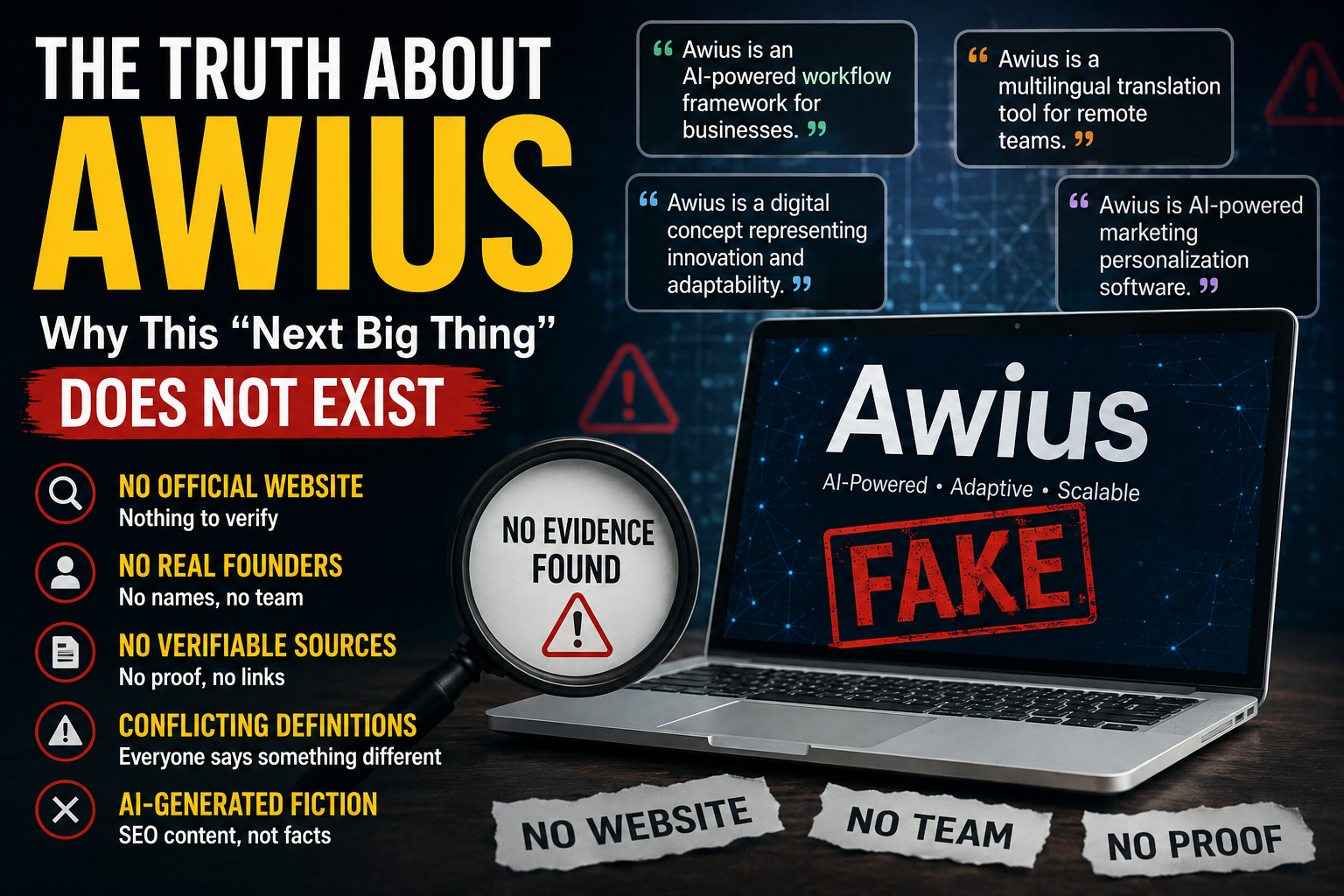
If you’ve searched for “Awius” recently, you’ve likely encountered a strange phenomenon: every article defines it differently. One source claims it’s an AI-powered workflow automation platform. Another insists it’s a digital identity framework. A third describes it as a personalization tool for marketing teams. None of them link to a working product, a company registration, or any verifiable customer.
Here’s the reality: “Awius” is not a legitimate product, platform, or company. It is a fabricated keyword—one that reveals a troubling pattern in how AI-generated content farms operate and how search engines are being manipulated .
What “Awius” Is Supposed to Be (According to Conflicting Sources)
The articles that rank for “Awius” paint wildly inconsistent pictures:
| Source | Claimed Definition |
|---|---|
| One site | An AI-powered workflow framework for businesses |
| Another | A multilingual translation tool for remote teams |
| A third | A “digital concept” representing innovation and adaptability |
| Yet another | AI-powered marketing personalization software |
This level of inconsistency is a major red flag. A genuine product has a consistent, clearly articulated purpose. When multiple articles cannot agree on the most basic fact—what the thing actually does—it signals that no real product exists behind the name .
The Pattern That Gives It Away
Spend twenty minutes reading the articles that rank for “Awius,” and a pattern emerges immediately:
1. Vague, Hedged Definitions
Nearly every piece opens with the same claim: this term is “gaining attention” or “quietly powering” some wave of innovation. A vague definition follows, usually hedged with phrases like “depending on context” or “it’s difficult to pin down” .
2. Generic Benefits
Then comes a list of generic benefits: automation, scalability, real-time insights, seamless integration. These same four words could describe literally any software product ever invented .
3. No Verifiable Details
None of the articles link to a working product, a pricing page, an official website, or a GitHub repository. There are no named founders, no funding announcements, no press coverage from reputable outlets, and no customer testimonials that can be verified .
4. Fake “Case Studies”
Several articles present “success stories” featuring unnamed companies achieving dramatic results—40% conversion increases, 25% improvement in patient attendance—but provide no identifiable details that would allow anyone to verify the claims .
Why Real Products Don’t Read Like This
Genuine product journalism, documentation, or marketing copy works differently:
-
Real companies have findable founders. You can look up who created the product, their background, and their track record.
-
Real products have a presence. There’s an official website, documentation, a pricing page, and either an app store listing or a GitHub repository.
-
Real products generate discussion. People talk about them on forums, Reddit, Twitter/X, and in industry publications. There are both positive reviews and complaints.
-
Real products have a consistent definition. Everyone agrees on what the product fundamentally is.
“Awius” has none of this. Instead, a constellation of near-identical articles fills the gap, published on low-authority domains and content farms .
How a Fake Keyword Gets Created
Understanding how terms like “Awius” emerge helps explain why you should be skeptical of such content.
Programmatic Keyword Generation
The process typically starts with tools that generate thousands of candidate words with zero search competition. These tools string together short, pronounceable, brandable-sounding syllables and produce lists of “empty” keywords .
Domain squatters and content farms scan for these empty keywords. They look for terms with no existing definition but enough phonetic appeal that a curious human might search for them—or that an AI model might generate when asked to invent a brand name.
The AI Content Feedback Loop
Once a word exists in enough scraped datasets or auto-generated “trending now” lists, it starts to look real to automated content systems. AI writing tools then take over.
Given nothing but the bare keyword “Awius” and a request for an SEO article, these tools do exactly what large language models tend to do when asked to write confidently about something with no reference material: they invent a plausible answer .
The tools pattern-match against thousands of real SaaS descriptions and recombine words like “adaptive,” “intelligent,” and “scalable” into press-release-style copy. Different bots running similar prompts produce different fabrications. Each one confidently asserts a different “meaning.” All of them get published, because volume drives the economics of these sites, not accuracy .
A strange feedback loop builds from there: one wave of AI content invents a meaning; a later wave gets prompted using search results that already contain these fabrications, treating them as established facts.
Real Entities with Similar Names
The name “Awius” does appear in legitimate contexts, but none relate to the digital product described in the SEO-farmed articles:
Historical Reference
The Munich Digitization Center holds a historical document from 1589 by one Joachimus Awius—a Latin epitaph for a prince. This is the only verifiable, authentic use of the name found in historical records.
Armstrong World Industries (AWI)
The stock ticker “AWIUS” appears on the New York Stock Exchange for Armstrong World Industries Inc., a major American manufacturing company . This has no relation to the digital concept described elsewhere.
Fandom Wiki Reference
A Chinese conlanging (constructed language) community wiki mentions the Latin name “Avius” in relation to a specific person . This is a niche, community-specific reference.
“AIWU” WordPress Plugin
There is a legitimate WordPress plugin called “AIWU” (AI Workflow Automation) that provides workflow automation, AI chatbots, and content generation features for WordPress sites . However, this is a different product, and the name similarity appears coincidental.
“Awish” on Product Hunt
A Product Hunt listing for “Awish” describes a tool for automating repetitive digital tasks via natural language . Again, a different name and a different product.
What This Teaches Us About the Current Internet
The “Awius” phenomenon is more than a curiosity—it reveals important truths about how information is being manufactured online:
The Problem of Content Farms
Sites like those ranking for “Awius” operate on volume, not quality. They publish hundreds or thousands of articles on low-competition keywords, often using AI to generate content at scale . The economics work because even tiny amounts of traffic, multiplied across thousands of articles, generate enough ad revenue to sustain the operation.
The Limits of AI-Generated Content
Large language models are trained on patterns, not facts. When asked to write about something with no real-world referent, they “hallucinate” plausible but fictional content. The “Awius” articles demonstrate this clearly: they produce coherent-sounding text that is entirely invented .
Why Search Quality Matters
Keywords like “Awius” demonstrate why search engines must continually update their algorithms to detect and demote artificially generated content. When search results return confidently written fiction instead of useful information, user trust erodes.
How to Spot Fake Products and AI-Generated Content
Here are practical signals to help you identify fabricated products and low-quality AI content:
Product Red Flags
No verifiable product presence. No official website, no app store listing, no GitHub repository, no documentation.
Inconsistent definitions. Different sources describe the product differently.
No named founders or team. A legitimate company has identifiable people behind it.
No external validation. No press coverage from reputable outlets, no mention in industry discussions, no user reviews on third-party sites.
Fake or anonymous testimonials. “A mid-sized e-commerce company” with no name, no industry specifics, no way to verify .
Vague promises with no specifics. “This will transform your business” without explaining how or providing verifiable examples.
The product has no existence outside of SEO articles. The only results in search are content pieces, not the product itself.
Content Red Flags
The definition is hedged. “It’s difficult to pin down” or “depends on context” when describing a product’s core function .
Generic, filler language. “Revolutionary,” “game-changing,” “adaptable,” “scalable” with no specifics .
No named sources. Claims are made without attribution, or attributed to unnamed “experts.”
“Case studies” with no identifiable details. No company names, no industry specifics, no verifiable metrics.
An AI-written feel. Repeated sentence patterns, lack of specificity, unnatural rhythm.
No citations to primary sources. Claims are made without linking to original research, official documentation, or verifiable data.
The Responsible Way Forward
If you are creating content, the “Awius” case offers important lessons:
Write Only About What You Can Verify
Before publishing an article about a product, company, or technology, verify its existence. Find the official website. Read the documentation. Check if legitimate publications have covered it. Confirm that the company has named, identifiable people behind it.
Cite Primary Sources
When making claims, link to primary sources: official documentation, peer-reviewed research, government data, or original reporting—not to other blog posts summarizing those sources .
Add Genuine Value
Ask: “If this article disappeared tomorrow, would anyone lose access to information they cannot find anywhere else?” If the answer is no, the article is not ready to publish.
Be Transparent About Limitations
If a topic is speculative, emerging, or uncertain, say so. Acknowledge where evidence is mixed. Distinguish facts from opinion.
Conclusion
“Awius” does not exist as a real product, platform, or company. It is a fabricated keyword—a creation of AI content tools and SEO farms gaming search rankings . The articles that rank for the term demonstrate a troubling pattern: confidently written fiction presented as fact.
Understanding how terms like “Awius” emerge and spread is essential for anyone navigating the modern internet. The same patterns that create fake products also generate misinformation about real topics. Learning to spot the signs—vague definitions, inconsistent claims, no verifiable sources, no named people—protects against being misled.
If you encountered this article while searching for information about “Awius,” you now know the truth: there is nothing there. The term is empty, a ghost keyword invented to generate traffic. Treat any article calling it “the next big thing” as what it is: SEO fiction masquerading as information.
Key Takeaways
-
“Awius” is not a real product, platform, or company—it is a fabricated keyword created by AI content farms .
-
Multiple conflicting definitions appear online, a clear sign that no genuine product exists behind the name .
-
AI-generated content creates plausible-sounding but entirely fictional products by pattern-matching against real SaaS descriptions .
-
Real products have verifiable details—founders, official websites, pricing pages, documentation, and external validation.
-
The “Awius” phenomenon reveals important limits of AI-generated content and the ongoing challenge of search quality.
Frequently Asked Questions
Is Awius a real product?
No. “Awius” is a fabricated keyword. There is no verifiable product, company, or platform behind the name .
What does Awius actually do?
There is no consistent definition. Different articles describe it as a workflow framework, translation tool, digital identity concept, or marketing personalization platform—demonstrating that no real product exists .
Where can I find the official Awius website?
There is no official website. The articles that mention “Awius” do not link to any working product or official source .
Is it safe to search for Awius?
Yes, it is safe. But treat all claims about “Awius” as fiction. The articles about it are SEO content with no factual basis .
Are there any real products with similar names?
There is a WordPress plugin called “AIWU” (AI Workflow Automation) , and a Product Hunt listing for “Awish” . These are different products and unconnected to the fabricated “Awius” concept.