

Any Time Interrogation (ATI): Meaning, Telecom Uses, Architecture, and Security
Introduction
A mobile network sometimes needs information about a subscriber without waiting for a conventional call or data session to finish. That is where Any Time Interrogation (ATI) comes into the picture.
The phrase can sound like a general interrogation technique, but in telecommunications it has a much more specific meaning. Any Time Interrogation is a network-signaling service used to request information about a mobile subscriber when that information is needed. In the 3GPP/CAMEL architecture, the service can involve systems such as the gsmSCF, HLR, GMLC, MSC/VLR, and SGSN, depending on what information is being requested.
That distinction matters because some websites use “any time interrogation” as a general phrase for questioning a person at an unexpected time. That is not the same technical concept. In telecom documentation, ATI is a defined signaling operation, historically associated with MAP and CAMEL-based mobile networks.
This guide explains the technical meaning of ATI, what information it can retrieve, how the request flows through a mobile network, where HLR and GMLC fit, why SS7 and MAP matter, and what security concerns operators must consider.
Read Also: Fundfire Insight: What It Is and What to Know in 2026
What Is Any Time Interrogation?
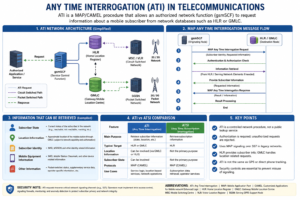
Any Time Interrogation (ATI) is a telecommunications signaling procedure that allows an authorized network application to request information about a mobile subscriber when required.
3GPP documentation describes the MAP-Any-Time-Interrogation service as a mechanism through which the gsmSCF can request information such as subscriber state or location from an HLR or GMLC. Depending on the destination, the service can also be associated with Mobile Number Portability information.
In simpler terms:
ATI allows an authorized mobile-network function to ask the network’s subscriber infrastructure for selected information about a particular subscriber.
The word “any” refers to the ability to make the query when needed rather than waiting for a predefined subscriber event.
It does not mean that every person, application, or third party can freely query any mobile subscriber.
ATI in one sentence
Any Time Interrogation is a network-level subscriber-information retrieval mechanism used in mobile telecommunications systems.
Any Time Interrogation vs. Ordinary Interrogation
The biggest source of confusion is the word interrogation.
In ordinary English, interrogation generally means questioning a person, often repeatedly or aggressively.
In telecommunications, however, interrogation means querying network information.
| Term | Meaning |
|---|---|
| Any Time Interrogation | Telecom signaling procedure for requesting subscriber information |
| Human interrogation | Questioning a person to obtain information |
| ATI | Common abbreviation for Any Time Interrogation |
| MAP ATI | ATI implemented through the Mobile Application Part signaling environment |
| Any Time Subscription Interrogation | Related procedure for retrieving subscription information |
So if someone searches for “any time interrogation meaning,” context is essential.
If the context involves HLR, SS7, MAP, CAMEL, GMLC, IMSI, MSISDN, subscriber state, or location, the intended meaning is almost certainly the telecommunications concept.
How Any Time Interrogation Works
ATI is easier to understand when viewed as a sequence rather than as an isolated command.
A simplified process looks like this:
- An authorized network application needs subscriber information.
- The gsmSCF initiates an ATI request.
- The request identifies the subscriber, commonly using an IMSI or MSISDN.
- The request specifies the information being requested.
- The relevant network database or location function processes the request.
- Additional network elements may be contacted to obtain current information.
- The requested information is returned to the requesting network function.
3GPP specifications describe separate information flows involving the gsmSCF and HLR or GMLC.
A simplified architecture
Authorized Application
        |
        v
     gsmSCF
      /   \
     /     \
   HLR     GMLC
    |        |
 MSC/VLR   Location
    |
  SGSN
The actual architecture depends on the network generation, requested information, and supported procedures.
The Role of the gsmSCF
The gsmSCF, or GSM Service Control Function, is an important component in CAMEL-based service architecture.
For ATI, the gsmSCF can initiate a request for information about a subscriber.
For example, the request may concern:
- Subscriber state
- Subscriber location
- Mobile equipment information
- Certain classmark information
- Other information permitted by the relevant implementation
3GPP material describes the gsmSCF as the initiating side for ATI procedures involving the HLR and GMLC.
The important point is authorization. ATI is not designed as an unrestricted public lookup service.
What Information Can ATI Retrieve?
The exact information available depends on the network implementation and applicable specifications.
3GPP documentation identifies several possible categories of information, including:
- Subscriber state
- Location information
- IMSI
- MSISDN
- IMEI
- Mobile-station class information
- Packet-switched subscriber state
- Certain network-specific information
The MAP specification defines request and response parameters for ATI, including subscriber identity and requested information.
Subscriber state
Subscriber state can help a network determine the current status of a mobile device or subscriber within the relevant domain.
This is different from knowing exactly what a person is doing. Network state is a technical condition maintained by the mobile infrastructure.
Location information
ATI can be used within appropriate network procedures to retrieve location-related information.
When the request involves a GMLC, the purpose is specifically associated with obtaining mobile-station location information.
The returned information should therefore not automatically be interpreted as a precise GPS coordinate.
Depending on the network architecture, location information can correspond to cellular-network location concepts rather than consumer GPS positioning.
IMEI
The International Mobile Equipment Identity (IMEI) identifies mobile equipment rather than the human owner.
This distinction is important:
IMSI/MSISDN → subscriber identity context
IMEI → equipment identity context
Mixing these concepts can lead to inaccurate explanations of ATI.
ATI, HLR, and GMLC: What Is the Difference?
These terms frequently appear together, but they perform different functions.
| Component | Main role |
| ATI | The interrogation/request procedure |
| HLR | Stores and provides important subscriber-related information in legacy mobile architectures |
| GMLC | Handles mobile location-related functions |
| gsmSCF | Network service-control function that can initiate ATI |
| MSC/VLR | Circuit-switched mobility and subscriber-serving functions |
| SGSN | Packet-domain mobility and subscriber information function in relevant legacy architectures |
| MAP | Signaling application protocol used by many legacy GSM/UMTS core-network procedures |
| CAMEL | Architecture for customized applications and service logic in mobile networks |
3GPP architecture documentation shows ATI interacting with HLR and GMLC, while HLR can obtain information from serving network elements such as the MSC/VLR or SGSN.
ATI and MAP
One of the most important technical relationships is:
ATI → MAP → Mobile core network
MAP, or Mobile Application Part, is a signaling protocol historically used within SS7-based mobile networks.
The standardized operation is known as:
MAP-ANY-TIME-INTERROGATION
3GPP documentation defines the service and its associated request and response primitives.
A typical legacy flow can look conceptually like:
gsmSCF
  |
  | MAP Any Time Interrogation
  v
HLR
  |
  | Provide Subscriber Information
  v
Serving Network Element
  |
  v
Information returned
The exact message flow depends on whether the interrogation is directed toward the HLR or GMLC and which domain is involved. ETSI documentation illustrates the MAP request and response sequence for ATI.
ATI and CAMEL
CAMEL stands for Customized Applications for Mobile network Enhanced Logic.
It was developed to allow operators to provide advanced services across mobile networks.
ATI appears within the CAMEL service architecture because network service logic may need information about a subscriber’s state or location.
3GPP documentation describes procedures such as:
CAMEL_ATI_GMLCCAMEL_ATI_HLR
The first relates to obtaining location information through the GMLC, while the second concerns retrieving subscriber state and/or location information through the HLR.
This makes ATI more than simply a database lookup. It is part of a broader service-control and signaling architecture.
A Practical ATI Example
Imagine a mobile operator running a network service that needs to determine whether a subscriber is reachable and obtain permitted network information about that subscriber.
The service-control application sends an ATI request.
The request identifies the subscriber and specifies what information is needed.
The HLR then processes the request. If current information must be obtained from another network element, the HLR can communicate with the relevant serving system.
The result travels back through the signaling path to the requesting application.
The important detail is that ATI does not itself magically create subscriber information.
It provides a standardized mechanism for requesting information that exists elsewhere within the network architecture.
Why Operators Use Any Time Interrogation
ATI can be useful when a network service needs subscriber information without waiting for another event.
Potential applications include:
Service logic
A service can make decisions based on permitted subscriber state or network information.
Location-related services
Where supported and authorized, ATI can interact with location-service infrastructure.
Network operations
Subscriber-state information can help network applications understand current conditions.
Specialized telecom services
CAMEL-based services can use subscriber information to determine how a service should behave.
3GPP specifications describe ATI as part of subscriber location/state retrieval and CAMEL service procedures.
Is Any Time Interrogation the Same as Phone Tracking?
No.
This is one of the most important distinctions.
ATI can be involved in retrieving location information in supported mobile-network architectures, but that does not mean ATI is a universal phone-tracking technology.
Several factors matter:
- Network architecture
- Operator configuration
- Authorization
- Requested information
- Subscriber identity
- Location-service procedures
- Security controls
- Network-generation differences
3GPP specifications describe authorization and operator-controlled behavior. For example, the HLR may reject interrogation requests from unauthorized service-control functions.
Therefore, an article claiming that anyone can use ATI to locate any phone would be misleading.
ATI and SS7 Security
ATI is also relevant to discussions about SS7 security.
Historically, mobile operators relied heavily on signaling networks that assumed a relatively trusted environment. As those networks became interconnected, unauthorized signaling became a major security concern.
A compromised or poorly protected signaling environment can create risks around subscriber information.
That is why modern telecom security depends on controls such as:
- Signaling firewalls
- Access control
- Network screening
- Authentication and authorization
- Monitoring
- Anomaly detection
- Operator-level policy enforcement
- Careful exposure of signaling interfaces
The existence of an ATI operation does not mean that the operation should be exposed indiscriminately.
Security depends on who can send the request, where it originates, what is requested, and how the receiving network validates it.
Common Misconceptions About ATI
“ATI means you can locate anyone.”
Not necessarily.
ATI is a standardized network function, not an unrestricted public tracking service.
“Any Time means the query works at literally any moment.”
The name describes on-demand interrogation capability. It does not override network availability, authorization, implementation limitations, or operator policies.
“ATI is a GPS feature.”
No.
ATI belongs to mobile-network signaling and subscriber-information procedures. Location information can be involved, but ATI itself should not be confused with GPS.
“ATI and Any Time Subscription Interrogation are identical.”
No.
They are related concepts, but Any Time Subscription Interrogation (ATSI) concerns retrieval of subscription information. 3GPP documentation separately describes the ATSI procedure.
“ATI is only about location.”
No.
Depending on the applicable specification and implementation, ATI can involve subscriber state and other information as well as location.
Any Time Interrogation vs. Any Time Subscription Interrogation
These terms are close enough to cause confusion.
| Feature | Any Time Interrogation | Any Time Subscription Interrogation |
| Common abbreviation | ATI | ATSI |
| Main purpose | Subscriber information retrieval | Subscription-information retrieval |
| Typical network element | HLR/GMLC | HLR |
| Location information | Can be involved | Not its primary purpose |
| Subscriber state | Can be involved | Focus is subscription data |
| CAMEL relationship | Yes | Yes |
The distinction becomes particularly important when reading older GSM/CAMEL technical documentation.
What Happens in an ATI Request?
At a high level, a technically valid ATI request contains information that allows the network to understand:
- Who is being queried
- What information is requested
- Which domain or network function is relevant
- Which authorized service-control entity is making the request
3GPP documentation identifies subscriber identity, requested information, and gsmSCF addressing among the important information elements.
The network then evaluates the request and returns either the permitted information or an appropriate error.
This is why ATI should be understood as a controlled signaling transaction, not as a simple public database search.
Expert Analysis: Why ATI Still Matters
ATI is historically rooted in GSM-era and CAMEL architecture, but the underlying idea remains useful for understanding mobile-network design: network services sometimes need controlled access to current subscriber information.
The architecture separates responsibilities.
The service-control function requests information.
The subscriber database provides or obtains relevant data.
Location functions handle location-related operations.
Serving network elements maintain current mobility information.
That separation is valuable because it reduces the need for every application to directly interact with every network database.
It also creates security boundaries.
A well-designed network should not treat every internal component as equally trusted.
Is ATI Still Relevant in Modern Networks?
Yes, but its relevance depends on the network generation and architecture.
Legacy GSM, GPRS, and UMTS systems used HLR, MAP, CAMEL, and related signaling technologies extensively.
Later mobile architectures introduced technologies such as:
- LTE
- Diameter
- HSS
- IMS
- 5G Core
- Service-Based Architecture
This does not mean the concept of querying subscriber information disappeared. Instead, the mechanisms and architectures evolved.
For example, 3GPP material documents the application of subscriber location/state retrieval concepts in later CAMEL-related environments, including HSS-related architecture.
So an engineer researching ATI in 2026 should always ask:
Which network generation and protocol stack are we talking about?
That question prevents many outdated explanations.
Any Time Interrogation Checklist
Before describing or implementing ATI, check the following:
-
Identify the exact 3GPP specification and release.
-
Determine whether the environment uses MAP/CAMEL.
-
Identify the requesting network function.
-
Identify whether the target is HLR, GMLC, or another supported function.
-
Determine what subscriber information is required.
-
Verify authorization and operator policy.
-
Confirm signaling security controls.
-
Check whether the requested information is actually supported.
-
Account for differences between network generations.
-
Avoid treating network location as equivalent to GPS.
-
Log and monitor sensitive signaling operations appropriately.
Common Mistakes When Explaining ATI
Mistake 1: Treating ATI as a general interrogation technique
This creates an entirely different article from the telecom meaning.
Mistake 2: Calling ATI a phone-tracking tool
ATI may participate in location-information retrieval, but its actual function is broader and more controlled.
Mistake 3: Ignoring authorization
The existence of a protocol operation does not imply that an arbitrary external party can invoke it.
Mistake 4: Mixing HLR and GMLC
They are related but serve different functions.
Mistake 5: Ignoring network generation
An explanation based entirely on legacy SS7 architecture may not accurately describe a modern 4G or 5G deployment.
Mistake 6: Confusing subscriber and equipment identity
IMSI, MSISDN, and IMEI identify different things and should not be treated as interchangeable.
Best Practices for Telecom Professionals
When documenting ATI for engineers, network architects, or security teams, the strongest approach is to describe the complete context.
Start with:
Protocol → Architecture → Requester → Target → Requested data → Authorization → Response → Security
For example:
A CAMEL service-control function sends an authorized ATI request toward the appropriate network function, specifying the subscriber identity and information required. The network processes the request according to its configured policies and returns the permitted result.
That explanation is more accurate than simply saying “ATI gets a phone’s location.”
For security teams, the focus should be broader still: monitor signaling behavior, restrict unnecessary access, validate source identities, and investigate unusual interrogation patterns.
Future Outlook
The future of ATI is best understood as part of the broader evolution from traditional signaling networks toward more service-oriented mobile architectures.
The underlying requirement remains familiar: network applications need controlled access to subscriber and service information.
The implementation, however, can change dramatically.
The long-term direction includes:
- Greater separation between services and databases
- Stronger authentication
- More explicit authorization
- Signaling security controls
- API-driven network functions
- Better monitoring and anomaly detection
- Migration from legacy SS7/MAP environments
- Increasing use of cloud-native network functions
For researchers, this means an old ATI diagram should never automatically be assumed to represent a modern 5G core.
Read Also: EYP Meaning: What It Means in Text, TikTok & Chats
Frequently Asked Questions
What does Any Time Interrogation mean?
In telecommunications, Any Time Interrogation (ATI) is a network signaling procedure that allows an authorized service-control function to request permitted information about a mobile subscriber from network functions such as an HLR or GMLC.
What does ATI stand for?
ATI stands for Any Time Interrogation.
What protocol is associated with Any Time Interrogation?
ATI is associated with the Mobile Application Part (MAP) signaling environment and CAMEL-based mobile-network architecture. 3GPP specifications define the MAP-ANY-TIME-INTERROGATION service.
Can ATI retrieve a subscriber’s location?
It can be used in supported network procedures to request location information. When the request involves the GMLC, the procedure is specifically associated with mobile-station location retrieval.
Does ATI mean someone can track any phone?
No. ATI is a controlled telecommunications function. Authorization, operator configuration, network architecture, and security policies determine whether a request is permitted.
What is the difference between ATI and ATSI?
ATI generally concerns subscriber information such as state or location, while Any Time Subscription Interrogation (ATSI) is designed to retrieve subscription information.
What is the role of the HLR in ATI?
In legacy mobile architectures, the HLR stores important subscriber information and can process ATI requests or obtain relevant current information from serving network elements.
What is the role of the GMLC?
The Gateway Mobile Location Centre (GMLC) is associated with mobile location services. ATI can use the GMLC when location information is being requested.
Is Any Time Interrogation still relevant?
Yes, particularly when studying GSM, UMTS, CAMEL, MAP, SS7, and legacy telecom signaling. Modern networks use newer architectures and protocols, so engineers should always identify the specific network generation under discussion.
Is ATI the same as GPS?
No. ATI is a mobile-network signaling procedure. Location information obtained through mobile-network systems should not automatically be described as GPS coordinates.