

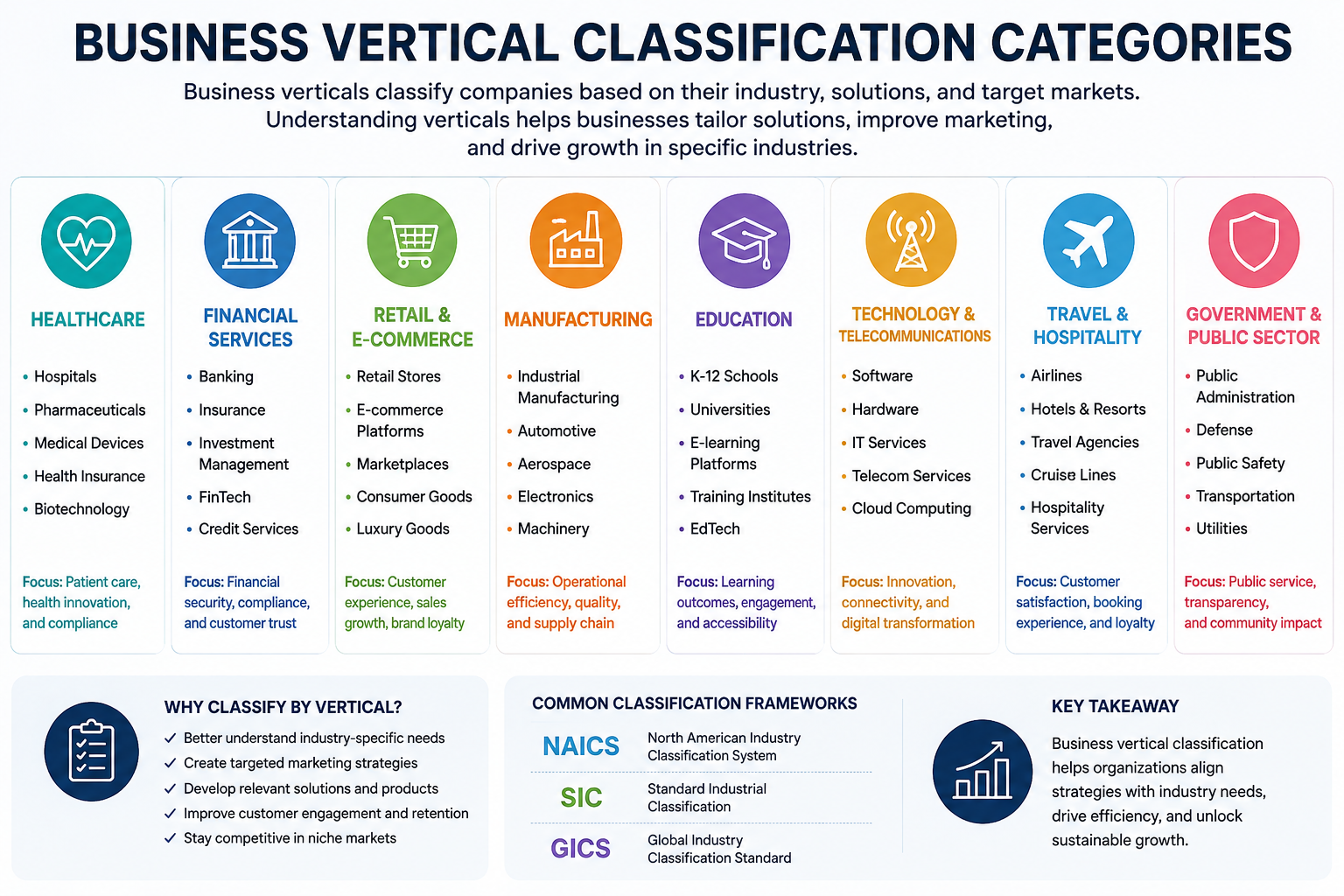
Business Vertical Classification Categories: Complete Guide to Industry Segmentation
Introduction
Imagine two software companies selling almost identical technology.
One sells scheduling software exclusively to dental practices. The other sells scheduling software to hospitals, gyms, salons, schools, and retailers.
Technically, both are software businesses. Strategically, they are very different companies.
The first operates within a clearly defined healthcare-related vertical. The second is closer to a horizontal software market. That distinction affects its audience, sales process, product roadmap, messaging, competitors, and even the way potential customers evaluate it.
That is where business vertical classification categories become useful.
Business vertical classification categories are structured ways of grouping companies according to the industries, markets, customers, products, services, or operating environments they serve. They make a complicated business landscape easier to analyze and help organizations create consistent industry segmentation.
There is one important qualification: a business vertical is not the same thing as an official industry classification code. A marketing team might call a company “healthtech,” while an official statistical system may place its activity under a particular NAICS industry. Those labels can coexist because they serve different purposes.
This guide explains the difference, covers the major categories, examines formal classification systems, and shows how to choose a useful vertical without forcing a business into the wrong box.
Read Also: Zavalio Com: What It Is, How It Works & Is It Legit?
What Are Business Vertical Classification Categories?
Business vertical classification categories are organized labels used to group businesses according to a shared industry, customer market, use case, or operating environment.
In practical terms, they answer a question such as:
“What specific market does this business primarily serve?”
For example:
- A hospital belongs broadly to healthcare.
- A company making hospital-management software belongs to healthcare technology.
- Software designed specifically for dental appointment management represents an even narrower healthcare sub-vertical.
- A platform built specifically for independent dental clinics could be described as a niche market within that sub-vertical.
The terminology is flexible because “vertical” is commonly used as a business and marketing concept rather than one universal global classification standard. Indeed, vertical markets generally refer to specialized markets centered around a particular industry or niche.
The hierarchy: sector → industry → vertical → sub-vertical → niche
A useful way to visualize the relationship is:
Sector → Industry → Vertical → Sub-Vertical → Niche
For example:
Technology → Software → Healthcare Technology → Practice Management → Dental Practice Software
This hierarchy is particularly useful for SEO, sales segmentation, competitive research, customer databases, and market analysis.
It also prevents a common mistake: assuming that a company can have only one label.
A business can simultaneously be:
- in the technology sector,
- part of the software industry,
- focused on healthcare,
- specialized in practice management,
- and targeting independent dental clinics.
Each description answers a different question.
Business Vertical vs. Industry vs. Sector
These terms are related, but they should not be treated as interchangeable.
| Term | Typical meaning | Example |
|---|---|---|
| Sector | Very broad economic grouping | Technology |
| Industry | Group of related economic activities | Software |
| Vertical | Focused market or industry served | Healthcare software |
| Sub-vertical | More specialized segment | Hospital management software |
| Niche | Narrow audience or use case | Scheduling software for dental clinics |
The distinction becomes particularly important when businesses conduct competitive research.
Suppose a company sells accounting software exclusively to law firms. Calling it simply a “software company” is technically reasonable but strategically weak. Its real competitive environment includes legal technology providers, specialized accounting platforms, and products designed around law-firm workflows.
The narrower classification reveals information that the broad classification hides.
Major Business Vertical Classification Categories
There is no single universal list of business verticals used by every organization. Classification depends on the purpose.
A marketing database might use 15–30 broad categories. A market-intelligence platform may use hundreds. An official statistical system can go considerably deeper.
For a practical business taxonomy, the following categories cover many common markets.
1. Technology and Software
Technology is one of the broadest modern business verticals.
It can include:
- SaaS
- Artificial intelligence
- Cybersecurity
- Cloud computing
- Data analytics
- Developer tools
- Enterprise software
- IT services
- Semiconductors
- Hardware
- Telecommunications technology
The category becomes more useful when narrowed.
For example:
Technology → SaaS → Cybersecurity → Identity Management → Enterprise Identity Platforms
The U.S. NAICS system treats information-related activities separately and includes software publishing, telecommunications, data processing, web hosting, and related activities within the Information sector.
Why classification matters here
Technology companies often cross industries. An AI platform might serve hospitals, banks, manufacturers, and retailers.
In that case, the company may have:
- a technology industry classification, and
- several customer verticals.
That distinction is valuable when creating landing pages and sales campaigns.
2. Healthcare and Life Sciences
Healthcare includes organizations involved in medical care, health products, research, and related services.
Common sub-verticals include:
- Hospitals
- Clinics
- Dental care
- Telemedicine
- Pharmaceuticals
- Biotechnology
- Medical devices
- Diagnostics
- Health insurance
- Healthcare IT
- Medical billing
- Digital health
Healthcare is particularly sensitive to classification errors because regulatory requirements, purchasing processes, and customer expectations can vary dramatically between subcategories.
A telehealth platform for hospitals should not necessarily use the same market positioning as a consumer wellness application.
The U.S. NAICS framework places health care and social assistance in Sector 62.
3. Financial Services and Fintech
Financial services covers businesses involved in money management, financial transactions, investment, lending, insurance, and related activities.
Common sub-verticals include:
- Banking
- Insurance
- Payments
- Lending
- Wealth management
- Investment management
- Accounting
- Financial software
- Fintech
- Credit services
- Financial infrastructure
Fintech illustrates why business vertical classification can become complicated.
A payment company may be:
Technology from a product perspective,
Financial services from a customer perspective,
and payments from a market perspective.
There is no contradiction. The correct classification depends on what the classification is intended to accomplish.
4. Retail and E-Commerce
Retail businesses sell goods to consumers or operate platforms that facilitate those transactions.
Subcategories include:
- Online retail
- Physical retail
- Marketplaces
- Direct-to-consumer brands
- Grocery
- Fashion
- Consumer electronics
- Beauty
- Home goods
- Specialty retail
An e-commerce business may also be classified by its product vertical.
For example:
Retail → E-commerce → Beauty → Skincare → Sensitive-Skin Products
That level of detail can be far more useful for marketing than simply labeling the company “retail.”
5. Manufacturing and Industrial
Manufacturing covers businesses that transform materials, components, or substances into products.
Common sub-verticals include:
- Automotive
- Electronics
- Machinery
- Chemicals
- Food manufacturing
- Textiles
- Aerospace
- Industrial equipment
- Packaging
- Consumer products
The official NAICS definition describes manufacturing as the mechanical, physical, or chemical transformation of materials, substances, or components into new products.
Manufacturing classification is often more specific than a general “industrial” label because different manufacturers have completely different supply chains, customers, regulations, and production economics.
6. Construction and Real Estate
This category covers businesses involved in building, property, development, ownership, leasing, and related services.
Examples include:
- Residential construction
- Commercial construction
- Property development
- Real estate agencies
- Property management
- Real estate investment
- Architecture
- Engineering
- PropTech
- Facilities management
A property-management SaaS platform, for instance, may be a technology company by product type but serve the real estate vertical.
That distinction should be reflected in its positioning.
7. Education and EdTech
Education businesses include traditional institutions and technology-enabled learning providers.
Common sub-verticals include:
- Schools
- Universities
- Vocational training
- Online learning
- Tutoring
- Learning management systems
- Corporate training
- Educational publishing
- Assessment technology
- EdTech platforms
Education companies often serve multiple audiences, including students, parents, teachers, institutions, and employers. Classification by customer can therefore be just as useful as classification by product.
8. Transportation and Logistics
Transportation and logistics cover the movement, storage, and coordination of people and goods.
Sub-verticals include:
- Freight
- Trucking
- Shipping
- Warehousing
- Courier services
- Last-mile delivery
- Aviation
- Maritime transportation
- Supply-chain technology
- Fleet management
In the 2022 NAICS structure, transportation and warehousing form Sector 48–49.
For logistics technology companies, a second layer of classification can be useful:
Technology → Logistics Technology → Fleet Management → Commercial Fleet Telematics
9. Energy and Utilities
This category includes businesses involved in producing, distributing, managing, or supplying energy and essential utilities.
Examples include:
- Oil and gas
- Electricity
- Renewable energy
- Solar
- Wind energy
- Water utilities
- Energy management
- Battery technology
- Grid technology
- Energy services
Energy businesses frequently operate under industry-specific regulations, making accurate classification particularly important for compliance and market analysis.
10. Agriculture and Food
Agriculture and food span the journey from primary production to consumer products.
Subcategories can include:
- Farming
- Livestock
- Fisheries
- Agricultural technology
- Food processing
- Food distribution
- Restaurants
- Grocery
- Food delivery
- Beverage production
The distinction between agriculture, food manufacturing, retail, and food services illustrates why different classification systems can produce different labels for businesses involved in the same supply chain.
11. Professional and Business Services
Professional services are organizations that primarily sell specialized expertise rather than physical products.
Examples include:
- Legal services
- Accounting
- Consulting
- Advertising
- Marketing
- Engineering
- Architecture
- Recruitment
- Research
- Design
- IT consulting
The U.S. Census Bureau’s NAICS Sector 54 includes professional, scientific, and technical services such as legal, accounting, architectural, engineering, computer, consulting, research, advertising, and related services.
12. Media, Entertainment, and Hospitality
This broad category includes businesses built around content, leisure, travel, accommodation, and experiences.
Sub-verticals include:
- Publishing
- Streaming
- Gaming
- Music
- Film
- Events
- Hotels
- Tourism
- Restaurants
- Recreation
Official classifications may separate these activities. For example, NAICS places arts, entertainment, and recreation in Sector 71 and accommodation and food services in Sector 72.
For internal business strategy, however, combining related markets can sometimes make sense.
Business Vertical Classification Is Not the Same as NAICS
One of the most important distinctions in this topic is between a practical business vertical and an official classification system.
NAICS
The North American Industry Classification System (NAICS) is an official classification framework used by the United States, Canada, and Mexico.
The 2022 U.S. structure organizes economic activity through hierarchical levels such as:
Sector → Subsector → Industry Group → NAICS Industry → National Industry
The U.S. Census Bureau lists 20 broad sectors in the 2022 system.
These include:
- Agriculture, Forestry, Fishing and Hunting
- Mining, Quarrying, and Oil and Gas Extraction
- Utilities
- Construction
- Manufacturing
- Wholesale Trade
- Retail Trade
- Transportation and Warehousing
- Information
- Finance and Insurance
- Real Estate and Rental and Leasing
- Professional, Scientific, and Technical Services
- Management of Companies and Enterprises
- Administrative and Support and Waste Management
- Educational Services
- Health Care and Social Assistance
- Arts, Entertainment, and Recreation
- Accommodation and Food Services
- Other Services
- Public Administration
The official structure goes much deeper than these broad categories.
SIC
The Standard Industrial Classification (SIC) is another established system, particularly relevant in U.S. regulatory and historical business data.
The U.S. Securities and Exchange Commission maintains an SIC code list, and SIC codes appearing in EDGAR filings indicate the type of business associated with a company.
GICS
Financial-market analysis uses another major framework: the Global Industry Classification Standard (GICS).
GICS is particularly relevant to investors and equity-market analysis. For example, S&P’s current S&P 500 sector breakdown uses GICS sectors.
The key difference
Think of it this way:
NAICS/SIC/GICS = structured classification frameworks
Business vertical = practical market-positioning concept
One should not automatically replace the other.
Vertical Market vs. Horizontal Market
This is one of the most common sources of confusion.
A vertical market focuses on a particular industry or customer environment.
A horizontal market serves multiple industries with a broadly applicable product or service.
Example
Consider payroll software.
A general payroll platform serving restaurants, hospitals, manufacturers, schools, and technology companies is horizontal.
A payroll platform designed exclusively for hospitals may be positioned vertically.
The horizontal product emphasizes broad functionality.
The vertical product can emphasize:
- industry-specific workflows,
- specialized reporting,
- compliance requirements,
- integrations,
- terminology,
- customer expertise.
Neither strategy is automatically better.
A vertical strategy can produce stronger specialization, but it may reduce the size of the immediately addressable market. A horizontal strategy can reach more potential customers but may face more competition and weaker industry differentiation.
How to Classify a Business Correctly
If you are building a CRM, website taxonomy, market report, SEO structure, or sales database, use a repeatable process.
Step 1: Identify the primary economic activity
Ask:
What does the business actually do?
Do not start with its marketing slogan.
A company calling itself an “AI company” may actually generate most of its revenue from consulting, healthcare software, advertising, or manufacturing.
Classify the underlying activity first.
Step 2: Identify the primary customer
Next ask:
Who buys the product or service?
Possible groups include:
- Consumers
- Small businesses
- Enterprises
- Governments
- Hospitals
- Schools
- Manufacturers
- Financial institutions
- Retailers
Customer type can reveal the appropriate vertical.
Step 3: Identify the problem being solved
A business can often be classified more accurately by its customer problem than by its technology.
For example:
AI technology → fraud detection → financial institutions
is more strategically meaningful than simply calling the company an “AI startup.”
Step 4: Identify the regulatory environment
This matters especially in industries such as:
- Healthcare
- Finance
- Insurance
- Energy
- Aviation
- Pharmaceuticals
Shared regulations can create a meaningful vertical even when businesses use different technologies.
Step 5: Choose the narrowest useful classification
Do not make the category unnecessarily broad.
But do not make it so narrow that the label becomes meaningless.
A practical classification might look like:
Technology → SaaS → Healthcare SaaS → Medical Practice Management
That is much more actionable than either “technology” or an extremely specific description that nobody recognizes.
A Practical Business Vertical Classification Table
| Vertical | Typical Sub-Verticals | Common Buyers |
| Technology | SaaS, AI, cybersecurity, cloud | Businesses, developers, consumers |
| Healthcare | Hospitals, pharma, telehealth, devices | Patients, providers, insurers |
| Finance | Banking, payments, insurance, fintech | Consumers, businesses, institutions |
| Retail | E-commerce, grocery, fashion, marketplaces | Consumers |
| Manufacturing | Automotive, electronics, machinery | Businesses, distributors |
| Real Estate | Property, construction, PropTech | Consumers, investors, businesses |
| Education | Schools, EdTech, training | Students, institutions, employers |
| Logistics | Freight, warehousing, delivery | Businesses, consumers |
| Energy | Utilities, solar, oil and gas | Consumers, businesses, governments |
| Agriculture & Food | Farming, food production, restaurants | Consumers, distributors |
| Professional Services | Legal, consulting, accounting, marketing | Businesses, individuals |
| Media & Entertainment | Publishing, gaming, streaming, events | Consumers, advertisers |
This is a practical business taxonomy, not an official replacement for NAICS, SIC, GICS, or another formal classification system.
Why Business Vertical Classification Matters
Correct classification can improve several parts of an organization.
Marketing
Marketing teams can create messages around industry-specific pain points rather than generic benefits.
SEO
A clear vertical structure makes it easier to develop relevant topic clusters and industry landing pages.
For example:
/industries/healthcare/
/industries/financial-services/
/industries/manufacturing/
Each can then contain appropriate subtopics.
Sales
Sales teams can segment prospects and develop industry-specific outreach.
Product Development
Product teams can prioritize features based on the needs of a defined customer group.
Competitive Research
Companies can compare themselves with the businesses customers actually consider alternatives.
Analytics
Consistent classification improves reporting. If one department calls a customer “healthcare” while another calls it “medical,” aggregated reporting becomes unreliable.
Expert Analysis: The Best Classification Is Usually Multidimensional
A common mistake is trying to force every business into one category.
Modern companies frequently operate across several dimensions.
Consider a company providing cloud software to banks.
It could be described as:
- Business model: SaaS
- Technology: Cloud software
- Industry served: Financial services
- Use case: Compliance
- Customer: Banks
- Market: B2B
- Geography: Global
- Sub-vertical: RegTech
These classifications are not competing descriptions.
They form a richer business profile.
For databases and analytics, a multidimensional taxonomy is usually more useful than a single “industry” field.
A strong CRM structure might therefore include:
Primary Industry + Sub-Industry + Customer Type + Product Category + Use Case + Geography
That approach prevents the common problem of using one overloaded category field to represent several different business concepts.
Common Business Vertical Classification Mistakes
1. Confusing product with industry
A company selling AI software is not necessarily in a single “AI industry” for every classification purpose.
AI may be its technology, while healthcare, finance, or logistics may be its target vertical.
2. Using categories inconsistently
If one sales representative uses “Healthcare,” another uses “Health,” and another uses “Medical,” reporting becomes fragmented.
Create controlled labels.
3. Making categories too broad
“Services” is rarely useful enough for strategic segmentation.
4. Making categories too narrow
A taxonomy containing hundreds of tiny categories may look sophisticated but become difficult to maintain.
5. Treating a vertical as permanent
Businesses evolve.
A SaaS company may initially serve marketing agencies and later expand into enterprise retail. Its classification should be reviewed when its actual business changes.
6. Confusing official codes with marketing terminology
A company can legitimately have an official industry code and a different commercial positioning.
Do not force marketing language to behave like statistical classification.
Business Vertical Classification Checklist
Use this checklist when creating a business taxonomy:
-
Define the purpose of the classification.
-
Identify the company’s primary economic activity.
-
Identify its primary customer group.
-
Determine the major industry served.
-
Identify relevant sub-verticals.
-
Separate industry from product and technology.
-
Consider regulatory environment where relevant.
-
Use official codes when formal reporting requires them.
-
Keep internal category names consistent.
-
Document classification rules.
-
Allow secondary verticals when justified.
-
Review classifications as the business changes.
Future Trends in Business Classification
Business classification is becoming harder because companies increasingly cross traditional industry boundaries.
An AI company might serve healthcare, finance, education, and manufacturing simultaneously.
A retailer might also operate:
- a marketplace,
- a logistics network,
- a financial-services product,
- and a technology platform.
That creates pressure for classification systems to become more flexible.
Three trends are especially important.
1. Multidimensional taxonomies
Instead of assigning one industry label, organizations increasingly need several attributes describing activity, customer, product, and market.
2. AI-assisted classification
Machine-learning systems can classify companies from websites, filings, product descriptions, and business databases. Human review remains important because automated systems can confuse a company’s technology with its actual industry.
3. Industry convergence
Traditional boundaries are becoming less obvious.
Fintech combines finance and technology. Healthtech combines healthcare and technology. PropTech combines real estate and technology. FoodTech combines food and technology.
The result is not that traditional industries disappear. Rather, businesses increasingly operate at the intersection of several categories.
Conclusion: How to Think About Business Vertical Classification Categories
Business vertical classification categories are best understood as a practical framework for organizing businesses into meaningful industry or market segments.
The important thing is not memorizing a giant list of categories. It is understanding why the classification exists and what decision it needs to support.
For a simple website taxonomy, broad categories such as technology, healthcare, finance, retail, manufacturing, education, logistics, and professional services may be enough.
For serious business intelligence, you may need a deeper hierarchy:
Sector → Industry → Vertical → Sub-Vertical → Niche
And when formal reporting is involved, use an established system such as NAICS or SIC rather than treating an informal marketing label as an official code. The U.S. Census Bureau’s NAICS framework provides a structured hierarchy down to detailed industry levels, while the SEC maintains SIC classifications for business types appearing in EDGAR filings.
The most useful classification system is therefore not necessarily the biggest one. It is the one that remains consistent, understandable, actionable, and appropriate to the purpose for which it was created.
Key Takeaways
- A business vertical is a focused market or industry segment.
- Vertical, industry, sector, product, and technology are not identical concepts.
- Companies can legitimately belong to multiple classifications.
- Vertical markets focus on specialized customer needs; horizontal markets serve multiple industries.
- NAICS and SIC are formal classification systems, while “business vertical” is commonly used as a practical strategic label.
- A hierarchy from sector to niche makes classification easier to manage.
- Consistent taxonomy improves marketing, SEO, sales, analytics, and competitive research.
- Modern businesses increasingly require multidimensional classification because industries overlap.
Read Also: Voozon Explained: What It Is & How It Works
Frequently Asked Questions
What are business vertical classification categories?
Business vertical classification categories are organized labels used to group companies by industry, market, customer group, products, services, or operating environment. They help organizations segment markets and make business comparisons more consistent.
What are the main business vertical categories?
Common categories include technology, healthcare, financial services, retail and e-commerce, manufacturing, real estate, construction, education, transportation, logistics, energy, agriculture, food, professional services, media, entertainment, and hospitality.
The exact list depends on the organization’s purpose.
What is the difference between a vertical and an industry?
An industry is generally a broader grouping of related economic activities. A vertical is usually a more focused market segment. For example, software can be considered an industry, while healthcare software can be a vertical.
Is NAICS the same as a business vertical?
No. NAICS is a formal industry classification system. A business vertical is a practical term used in strategy, marketing, sales, and market segmentation. A company can use both.
What is the difference between a vertical and a horizontal market?
A vertical market focuses on a particular industry or specialized customer environment. A horizontal market provides products or services that can be used across multiple industries.
Can one company belong to multiple business verticals?
Yes. This is increasingly common. A technology company may serve healthcare, finance, and manufacturing customers while remaining a technology business by product category.
How do I choose the right business vertical?
Start with the company’s primary economic activity, then identify its main customers, problems solved, industry environment, and relevant sub-vertical. Choose the narrowest classification that remains accurate and useful.
Why is business vertical classification important for SEO?
Clear vertical classification can help organize industry-specific content, landing pages, internal links, and topical clusters. It also helps align content with the terminology and problems used by a particular audience.
Should businesses use NAICS codes on their websites?
Usually not as the primary customer-facing label. NAICS is designed for formal classification and statistical purposes. A website should generally use terminology that its customers understand, while maintaining official codes separately when needed.
How often should a company review its classification?
Review it whenever the company’s products, customers, revenue mix, or market positioning materially changes. Fast-growing businesses may need periodic taxonomy reviews to prevent outdated categories from affecting reporting and strategy.