

Ever found yourself reading a French text, hit the word traqueur, and wondered: is this about hunting, stage fright, or something else entirely? You’re not alone. The confusion makes sense—this single French word carries multiple meanings that shift dramatically depending on context. Here’s what you need to know.
What This Article Delivers
By the end of this guide, you’ll be able to translate traqueur accurately across its three distinct meanings, recognize which usage is appropriate from context, and pronounce it like a native speaker—no awkward guesswork.
The Three Meanings of “Tracqueur” in English
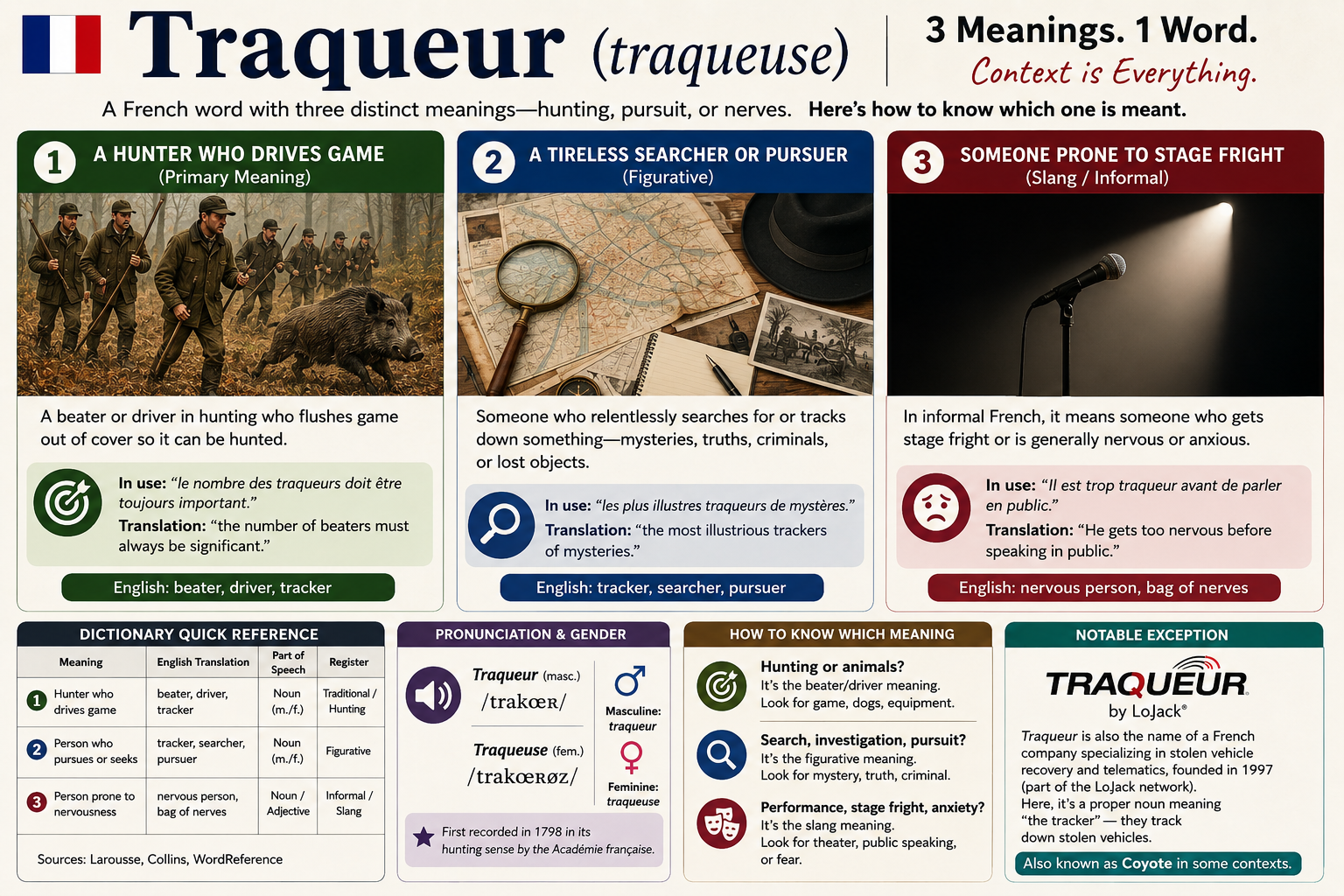
The word traqueur (feminine: traqueuse) has three separate definitions. Two relate to hunting and pursuit; the third is slang for nervousness.
A Hunter Who Drives Game (The Primary Meaning)
In its core, traditional sense, a traqueur refers to a beater or driver in hunting—someone employed to flush game out of cover so it can be hunted. This is also translated simply as tracker.
The role is specific: beaters form a line, advancing slowly through the brush with sticks, driving the animal toward the hunters waiting at the other end. It’s not about spotting or killing—it’s about pushing the quarry out of hiding.
In use: The phrase “le nombre des traqueurs doit être toujours important” (the number of beaters must always be significant) appears in a 1945 text describing proper hunting procedure. The translation driver captures the action, while tracker focuses on the pursuit aspect.
A Tireless Searcher or Pursuer (Figurative)
The word extends beyond hunting to describe anyone who relentlessly searches for or tracks something down. This figurative use applies to people pursuing mysteries, truths, criminals, or lost objects. The English equivalents include tracker, searcher, or pursuer.
In use: In a 1919 text, the writer refers to “les plus illustres traqueurs de mystères”—the most illustrious trackers of mysteries. A modern example from the Collins Corpus describes a photographer as “traqueuse de vérité plus que de beauté” (a seeker of truth more than beauty).
This usage captures the persistent, almost obsessive quality of the pursuit. Think of a bounty hunter, a private investigator, or a journalist who doesn’t stop digging.
Someone Prone to Stage Fright (Slang)
This is the wild card. In informal, colloquial French, traqueur/traqueuse means someone who gets stage fright or is generally nervous or prone to anxiety—from the word trac meaning stage fright or nerves.
In use: “Elle ne pourra tenir le premier rôle, elle est trop traqueuse” translates as “She won’t be able to handle the lead role, she gets too nervous”. The Larousse dictionary defines it simply: “Se dit de quelqu’un qui est sujet au trac”—someone who is prone to stage fright.
This meaning has a completely different register from the hunting definition, and confusing the two would be a significant mistake.
What the Dictionary Says: A Quick Reference
Here’s the breakdown of translations from authoritative French-English dictionaries:
| Meaning | English Translation | Part of Speech | Register |
|---|---|---|---|
| Hunter who drives/flushes game | beater, driver, tracker | Noun (masculine/feminine) | Traditional/Hunting |
| Person who pursues or seeks | tracker, searcher, pursuer | Noun | Figurative |
| Person prone to nervousness | nervous person, bag of nerves | Noun/Adjective | Informal/Slang |
Sources: Larousse, Collins, WordReference .
Pronunciation and Gender
The pronunciation is /tʀakœʀ/ for the masculine form and /tʀakœʀøz/ for the feminine. The feminine form, traqueuse, exists for both the hunting and slang meanings—a nervous female performer and a female hunter are both traqueuse.
The word’s first recorded use dates to 1798 in its hunting sense, appearing in the Académie française dictionary at that time. The figurative and slang uses developed later.
How to Know Which Meaning Is Intended
Context is everything. Here’s the cheat sheet:
-
If the topic is hunting or animals: it’s the beater/driver meaning. Look for references to game (gibier), dogs, or hunting equipment.
-
If the topic is search, investigation, or pursuit: it’s the figurative tracker/searcher meaning. Look for words like mystère, vérité, or criminel.
-
If the topic is performance, stage fright, or anxiety: it’s the slang meaning. Look for references to theater, public speaking, or fear.
The overlap between hunting and pursuing is natural—both involve tracking or chasing. But the stage fright usage is entirely separate.
A Notable Exception: The Traqueur Company
There’s one more use worth knowing: Traqueur is also the name of a French company specializing in stolen vehicle recovery and telematics, founded in 1997 and part of the LoJack network. In this case, it’s a proper noun referring to the company, not the common noun. The company’s name aligns with the “tracker” meaning—they track down stolen vehicles. The company is also known as Coyote in some contexts.
Key Takeaways
-
Primary meaning: a traqueur is a hunter who drives or flushes game—a beater or tracker.
-
Figurative meaning: the word describes anyone who relentlessly pursues or searches for something—a tracker of mysteries or truth.
-
Slang meaning: in informal French, it means nervous or prone to stage fright (trac).
-
Pronunciation: /tʀakœʀ/ (masculine) and /tʀakœʀøz/ (feminine).
-
Context is essential: the meaning changes entirely based on the subject matter.
Frequently Asked Questions
What is the feminine form of traqueur?
The feminine form is traqueuse . It’s used for both the hunting/pursuit meanings and the slang meaning for nervousness.
Is traqueur a common word in French?
It’s not an everyday word in casual conversation, but it appears in literature, hunting contexts, and more formal writing. The slang usage is recognizable to native speakers but tends to appear in specific contexts like theater or performance discussions.
Is traqueur related to the English word “tracker”?
Yes—etymologically, they share origins, and tracker is the most common direct translation for the pursuit and hunting senses. The connection is clear: both involve following a trail.
Can traqueur be used to describe someone who stalks people?
Yes, in the sense of a persistent pursuer, tracker or stalker are possible translations. However, it is less commonly used for the negative connotation of harassment and more often for literal or figurative pursuit.
Why does traqueur mean both “hunter” and “nervous”?
The two meanings come from separate roots. The hunting meaning comes from the verb traquer—to track or hunt. The “nervous” meaning comes from the word trac (stage fright) and is a completely separate usage. They just happen to share the same spelling.